
A man hears his car alarm begin blaring. It’s the mid-1980s, near the water tower at 20th and Grand, in North City. The man steps outside his duplex and sees a boy standing there. The boy is Antwane White, who lives across the alley with his mom, granny, and siblings. He has knocked on the door before without success, so now he’s trying a different approach: Having learned the man’s work schedule and waited for him to come home, he has triggered the car alarm, knowing that the man will need to go to the front of the car to silence it. How you doin’? the boy asks. I’m busy, the man says.
Decades later, White, now 48 years old, can recall these specific details of being rejected by his biological father. He cannot access the emotions; perhaps his mind has locked those away, he explains. Regardless, the outcome was unmistakable: “I stopped going.”
Get a fresh take on the day’s top news
We will never send spam or annoying emails. Unsubscribe anytime.
Not long after, White’s life spiraled into darkness. However, that was not where his story ended. His life demonstrates that while growing up without a father can wound a person deeply, those wounds do not have to determine one’s destiny.
Fathers matter to St. Louis because, eventually, the region’s future—perhaps even its survival as a livable and workable place—will rest on the strength and determination of today’s children, and children tend to thrive when their fathers actively participate in raising them. The word “tend” is chosen with care here: Human relationships are complicated, and preventing children from knowing their fathers to conduct a social experiment is unethical, so much of the current research is suggestive rather than conclusive.
Nonetheless, according to a recent book edited by researchers at the Harvard Kennedy School, a “growing body of evidence” demonstrates that fathers play a crucial role in children’s cognitive, psychosocial, educational, and behavioral development—including whether they attend school or engage in dangerous activities. Although two loving parents of any gender or sexual orientation are preferable for children than one parent alone, the editors note, “the significance of active fatherhood is now undeniable in ways it wasn’t in previous decades.”
In fact, in Missouri’s state capital, where the two major political parties rarely agree on anything, this represents a remarkable instance of bipartisan agreement.
State Rep. Jamie Ray Gragg of southwest Missouri understood this on January 27, when he presented before a committee in the state House of Representatives. His objective: convince his fellow representatives to approve, for the second consecutive year, his proposal to establish the Missouri Fatherhood Engagement Project. “It is called a ‘father’ bill,” the Republican told his colleagues. However, he stressed, “It’s actually a kid’s bill.” This distinction is vital, he explained, because “our children … are our future.” He recalled Whitney Houston. “Not to reference an old ’80s song, but yes.”
Gragg felt confident because both Democrats and Republicans appeared interested in his concept. The plan was to create a state-supported fund intended to help estranged fathers reestablish relationships with their children. The fund could receive contributions from various sources—state or federal funding, charitable gifts—but its purpose would not be to convince dads to value their kids. Rather, Gragg aimed to help dads who already care deeply but face practical obstacles, whether legal, employment-related, or involving the foster care system. Gragg’s strategy was for the state’s Division of Social Services to distribute grants to regional groups that assist dads in removing such obstacles.
Florida has already established such a program, which has given funds to organizations like the faith-based nonprofit Man Up and Go. The group’s manager of strategic advancement in southwest Missouri, Tim McConville, mentors dads who have had their kids placed in foster care (or are at risk of it) and supports them in attending required appointments, managing the system, and maintaining positive outlooks. McConville spoke to the committee about how his phone constantly rings with requests from caseworkers at Missouri’s Children’s Division and nonprofit organizations. “They’re always asking me, ‘Tim, can you help this dad?’ And I have to restrict my involvement because I can’t be everywhere at once. And that’s what this bill would do—allow us to expand this work on a broader scale.” Foster care placement costs state residents roughly $20,000 annually, McConville noted. “If we can prevent that, it helps the kids. It helps all of us.”
After McConville spoke, Rep. Raychel Proudie, a Democrat from Ferguson, chimed in. “It just makes practical sense in every way,” she said. “I support this bill.”
Proudie was not alone among Democrats. On February 25, during debate on Gragg’s proposal in the full chamber, Rep. LaKeySha Bosley of North City said: “I completely agree with this bill.” Rep. Marlene Terry of North County expressed the same view. “Unless you’ve personally experienced or witnessed a situation requiring something like this,” Terry noted, “you likely won’t understand.”
Some Republicans with libertarian leanings opposed the bill, seeing it as government overreach into personal affairs. “I’m not certain I’m comfortable with government attempting to reshape society into being better,” said Rep. Bryant Wolfin of Ste. Genevieve. But his fellow Republicans disagreed. One quoted the Republican Party’s official platform, which states, “Republicans back measures that strengthen families.” At another hearing in March, another Republican agreed that limiting state authority over families is important, “but the problem is nobody’s volunteering, and nobody’s willing to take this on.”
Although the House approved the bill without significant opposition, the bill failed in a Senate committee, where members from both parties voted against it. Nevertheless, despite disagreement over the right answer, there was widespread agreement on the problem: Fatherlessness is damaging Missouri. Gragg referred to it as “an epidemic.”
The state is not exceptional in this regard. In 2020, 17 percent of Missouri homes with kids were managed by single mothers—the national average as well. Yet the statewide percentage conceals important differences between neighborhoods. In St. Louis, for instance, multiple neighborhoods in North City and North County (and nowhere else) had over 50 percent of homes with kids headed by single moms.
The reality that many kids live with single moms doesn’t necessarily mean their fathers play no part in their upbringing. As Richard Reeves notes in his well-known book Of Boys and Men, “Excellent fatherhood doesn’t depend on living together. What counts is the bond.”
However, at the societal level, father presence seems to be strongly linked to children’s financial prospects. In the early 2010s, economists working at the Harvard-based nonprofit Opportunity Insights obtained anonymized tax records from millions of Americans spanning many years. This data enabled them to examine how earnings changed between generations and across regions. One of their key discoveries, detailed in a 2014 study, was that areas with fewer single-parent households had greater rates of upward economic movement. The researchers couldn’t say whether having high numbers of single parents directly reduced mobility, only that these factors went hand in hand.
They also found that family structure alone didn’t explain everything. Their research revealed that in general, “Black and white boys show vastly different financial outcomes even if they were brought up in two-parent families earning the same income, with the same education and resources, living on the same block, and studying in the same schools.” It was evident that father presence by itself hadn’t bridged the racial wealth gap.
Nevertheless, in certain neighborhoods, that racial gap was less pronounced—and the researchers concluded from this that “the inequality between Black and white boys in economic advancement is caused mostly by environmental factors that can be modified.” Using their extensive IRS database and census information, they discovered that Black boys specifically had higher earnings as grown-ups if they’d relocated as kids to neighborhoods where three conditions held true: income levels were minimal, white people showed limited racial prejudice, and a substantial portion of Black kids lived with their dads. Once more, the researchers avoided making strong statements about how much, if at all, any one of those factors specifically improved Black boys’ financial outcomes. Perhaps they were dealt with differently, the researchers speculated, or perhaps they gained from “coaching by Black male role models in their neighborhoods.”
In any event, “coaching initiatives for Black boys” was one program that the Opportunity Insights researchers determined could “be among the most effective in reducing the inequality between Black and white kids.”
Male coaching is something that Antwane White didn’t have—not at first, anyway.
Selling narcotics, criminal groups, street life: All “simply part of daily life,” White describes his boyhood in North City. In his seventh-grade year he was apprehended for car theft and served time in juvenile prison. This didn’t change him. He says committing theft gave him a sense of strength—like he possessed influence, even momentarily. He wanted to demonstrate to his community how powerful he was; his biological father’s opinion didn’t matter. “Perhaps I was trying to earn respect from others to compensate for the father figure who wasn’t present,” he reflects.
White’s daughter was born when he turned 20, yet he was not there for the first six years: He was imprisoned for robbery starting in 1998 and wasn’t freed until 2004. “Getting out didn’t feel like a fresh start,” he says, “but I found myself with the same crowd.” His son, Antwane Jr., came into the world in 2008. It was during this period that White made what he considers one of his greatest errors. He was watching his son and a young nephew, whose diaper had become soiled. The specifics of the following events were “highly questioned” in court, according to court filings, but everyone acknowledged that to clean the baby, White put him in bathwater that was too hot without checking the temperature first, causing the boy to get severe burns on his thighs. White immediately alerted the boy’s mother, who got him medical attention; the boy spent several weeks hospitalized. White has consistently claimed the injury was unintended, and the jury couldn’t reach a consensus on a first-degree assault charge, which would have demanded proof that he deliberately harmed his nephew; instead, they found him guilty of second-degree assault, which required showing “recklessness.”
Because White had previous convictions, he received a 15-year sentence for this conviction. During his incarceration, he was involved in gang activities and “occasionally involved in drug dealing.” Family visits caused him pain, he says, because he couldn’t be involved in their day-to-day lives. “I’d talk to my son daily on the phone,” he remembers. “I kept thinking, Man, I don’t want to return home in this state…just lying in bed, staring at the roof, contemplating where I ended up.” Sometime in 2015, White resolved that to be a good dad to his kids, he needed to transform himself mentally. He’d learned about the state-run Transition Center that operates as a transitional residence in the Near North Riverfront area. As he prepared for release, he sought admission and was granted it.
Among the services he found was the Fathers & Families Support Center—the kind of group that would probably qualify for funds from a potential Missouri Fatherhood Engagement Project.
Started in 1998, the organization initially offered a short-term course for primarily low-income, non-residential fathers who aspired to become better men and better parents—organized “boot camps” emphasizing discipline and teaching emotional control. These days, the organization runs separate initiatives focused on parenting and job training. Perhaps someone needs professional guidance, assistance resolving a custody or child support issue, or even transportation to get a birth certificate so he can get a truck driving permit. The support center provides these services.
The Transition Center also operates a reentry initiative for folks departing prison. It reports a repeat crime rate of 7 percent, lower than Missouri’s overall 35 percent repeat crime rate. White began his stay here in 2019.
Charles Barnes, the project administrator, remembers White arriving. “I told him, ‘I will keep an eye on you during your time with me.’ And he said, ‘I want that. I need that.’ I said, ‘I will hold you to your word.’ And during the six weeks in my program, and afterward, he demonstrated he was prepared to be accountable.”
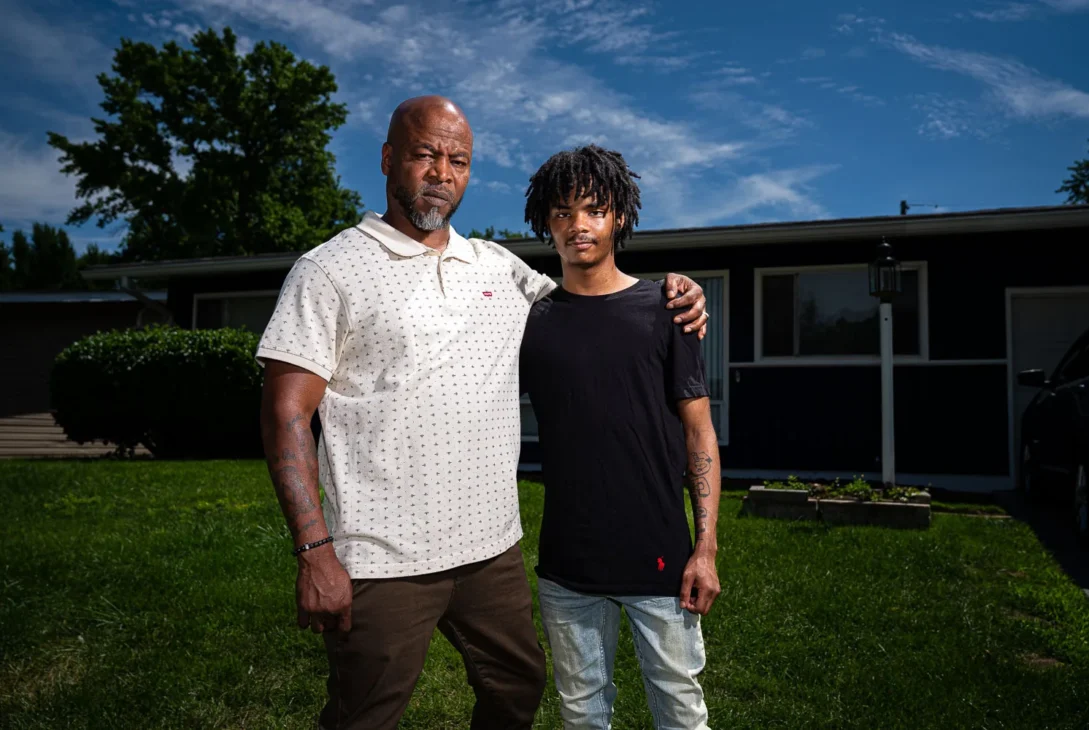
For starters, White rebuilt his relationship with his children. On his first available free time away from the center, he surprised his son Junior by appearing at the gate of his school. “I can still see him coming outside and hurrying toward me for that tremendous embrace,” remembers Antwane Jr., now 18. “I really missed him. I really did.” They dined at Denny’s, purchased Junior a phone. “He expressed remorse for not being there during most of my childhood,” Junior adds. “He apologized numerous times.” Not long after, White got complete parental rights.
But he needed somewhere to sleep. When White found an apartment owner who would lease to him, he reached out to the support center. “They told me, ‘We’re here for you. We’ll meet you at 9:30 tomorrow morning,'” he remembers. “The next morning at 9:30, they arrived, wrote a check. I moved into the place…They deliver on their promises if you follow through on yours.”
He got a position at the shuttered Blondie’s restaurant on Washington Avenue preparing food, then landed another job at a hospital supply business that manages bed linens—and afterward moved to that company permanently. Why? The job offered opportunities for advancement. Delivery workers could grow their customer lists by getting new clients and earning bonuses on those accounts. So White invested years expanding his accounts, maintaining the drivers’ unusual hours: Wake up at 1 a.m., begin work around 2 a.m., wrap up the deliveries by 10 a.m., sleep by 6 p.m.
By the point when Diane Santiago, a sales manager, started the job in 2022, White had achieved a recognized position in the driver rankings. “We call him ‘The OG’ because he’s been working there for years, and he’s older than some drivers, and they admire him because of his natural authority.”
Santiago’s responsibility included going on routes with drivers to help build customer relationships and increase sales: Who handles your mat cleaning? At first, the drivers seemed closed off and preferred things to stay the same, with little openness to Santiago. White stood out. He welcomed her on his deliveries and asked her lots of questions—even though he kept his own thoughts to himself at the beginning. “He was somewhat reserved,” she explains. But she saw how he made a point of saying “good morning” to people before discussing sales. How his clothing was always pressed. How he was methodical, stuck to the rules, and stayed organized, without ever having to be prompted to do his job. He jokingly said to her, “You going to help me earn more cash?”
“Neither one of us died
on these streets,” he says.
“And here we are now, older
and earning real money.”Antwane White
She helped. His annual compensation increased by around $35,000 over their year together. “It moved me up into a bracket where you’re upset with taxes,” he jokes.
White states, and Santiago verifies, that his customer base now generates over $150,000 annually. His sibling operates a transport business, he mentions, that brings in much more. White attributes their success to their mom, Mary Ann White, who worked extensive shifts, including weekends and holidays, to provide for them and her other three kids.
White often reflects, when he and his sibling hang out and share a beer, about their difficult beginnings. “We both made it out of these streets alive,” he says. “And we’re doing well financially now, supporting and caring for our families, the way we’re supposed to. And I regularly say to him, ‘Brother, if people knew our backstory.'”
That’s the same message White communicates to men at the Transition Center: Achievement is within reach. He periodically gets a phone call from Barnes, sitting in a room with guys who aren’t enthusiastic about being there. On the call, White describes his personal story. “Guys returning home may face hardship,” he explains, “might think progress is impossible. I want to be an example and show them it’s achievable…But if you’re not prepared to put in the effort, nothing changes.” Barnes has also connected many participants to White. White talks with most by phone; some he meets personally. Similar to Barnes, White doesn’t soften his words. “We share the same background, guys I’m talking to,” he says. “So I’m not going to be soft. You’re not soft. So I’m not going to let you disrespect me…When you reach out and say you’re struggling, I’ll listen without interrupting. But if those struggles are from bad choices you made, then I’m going to be honest with you.”
Barnes regularly hears their reactions firsthand. “The guys say, ‘I finally have somebody who really understands me.’ It’s often surprising.”
White’s economic achievement by itself is remarkable: Per research conducted by Opportunity Insights, kids who grew up in North City when White did have among the region’s lowest chances of moving up economically from where their parents started. In this respect, White is unusual. The question remains whether a household pattern of restricted wealth can be broken by one man’s determination.
The Opportunity Insights team found that for poor Black kids, having many Black fathers present in the community came with financial rewards that showed up later in life, even if a kid’s biological father wasn’t there. In terms of what kids made as grown-ups, they found that neighborhood-wide circumstances mattered more than individual circumstances.
In that regard, Junior faces some challenges: The man has already experienced much of his youth in poor neighborhoods in St. Louis, and presently, he says, “The majority of my buddies have single moms…I don’t have any buddies living with their dad.”
Yet Junior does, in fact, live with his biological father—and his father is working to move him forward financially. White not too long ago sat with his two children—his daughter works for Amazon, his boy is employed at Wendy’s—and made clear that they should be setting aside funds so that, for instance, when their vehicles break down, they can pay to fix them without seeking his help.
Following that discussion, White came up with something new. He was thinking of the contributions his company matches for his retirement funds. He devised a scheme: If his kids put money into savings and deposited $5 every day, he would contribute the same amount. He offered the concept through a text message. “Look, take this seriously,” he communicated, “and let’s build up money.” His girl replied: “I’m on board.” Junior answered with a fist-bump emoji.
Junior aspires to walk in his dad’s footsteps—wants to eventually get his commercial driver’s license, learn to drive trucks, save up cash, and buy a property rather than renting. He’s fixated on generating money the same way his dad is.
However, that’s not all. Regularly, they relax on Antwane Sr.’s back porch, chat about games and important topics. Says Junior: “I wish he’d been there for more of my growing up. But he’s turned things around. He’s made up for lost time.”
If studies eventually demonstrate that father absence harms upward economic movement, then a solid foundation will exist for bills like the proposed Missouri Fatherhood Engagement Project—and a method to allocate government funds to groups like the Father & Family Support Center. The organization reported that it supported 267 fathers in maintaining or landing positions with above-minimum wages in 2025, and that from 2019–2024, it helped its program participants pay almost $6 million in child support combined.
Not every participant successfully finishes their courses. Roughly 30 percent leave the program early. “We work with real people,” says chief operations officer Destini Goodwin. She notes that numerous individuals have hidden emotional wounds. Reginald Slaughter, who coordinates outreach efforts, acknowledges that not every participant is prepared to examine these emotional wounds, but others simply won’t abide by the rules—arriving on schedule, dressing properly, or speaking respectfully about their children’s mom. Some object to being told that their substance abuse, attitude, or family violence is the real reason they can’t be with their families. “If you don’t hold yourself responsible,” Slaughter says, “you won’t make it through our program.”
And even successful completion doesn’t conclude the journey. Consider Caron Perkins, who is 26. In his recently cleaned-up Normandy place, he explains that at 19, while on a college football team at Culver-Stockton College, his girlfriend of a few months became pregnant with twin girls. “I almost cried as they were being born,” he says. “Seeing them come into the world and cradling them…This was one of the best days of my existence. I’m really grateful. I’m appreciative of that gift.”
The relationship deteriorated after that. In 2025, the mother submitted a request to the court to make Perkins pay child support. However, after someone at the school informed an abuse hotline about the mom, state officials started examining whether Perkins could be trusted to parent the girls—and one caseworker suggested he contact the Fathers & Families Support Center.
Perkins was reluctant. But his first session in the six-week curriculum changed his perspective. “The instructor—you could see he’d gone through what we’ve all gone through. So I was like, OK, this person can probably guide me.” What helped Perkins most was individual counseling. “There were situations from different chapters of my history that I kept secret,” he explains. “They were distressing. But working through them with the counselor, I’ve been able to heal.” He rejects the notion that counseling is harmful. “Other people might believe, It will make you less of a man…. What counts is you, not what others say.”
In addition to advice for managing tough moments and controlling his emotions, he benefited from guidance on job hunting and workplace interaction. Perkins graduated from the organization in May. Currently, he’s working as a personal trainer—while also caring for his twin daughters, who turned 6 not long ago. Yet he’s also begun considering a profession in property dealing through the center—possibly developing a household venture. “Something,” he says, “that I can hand down to my daughters.”